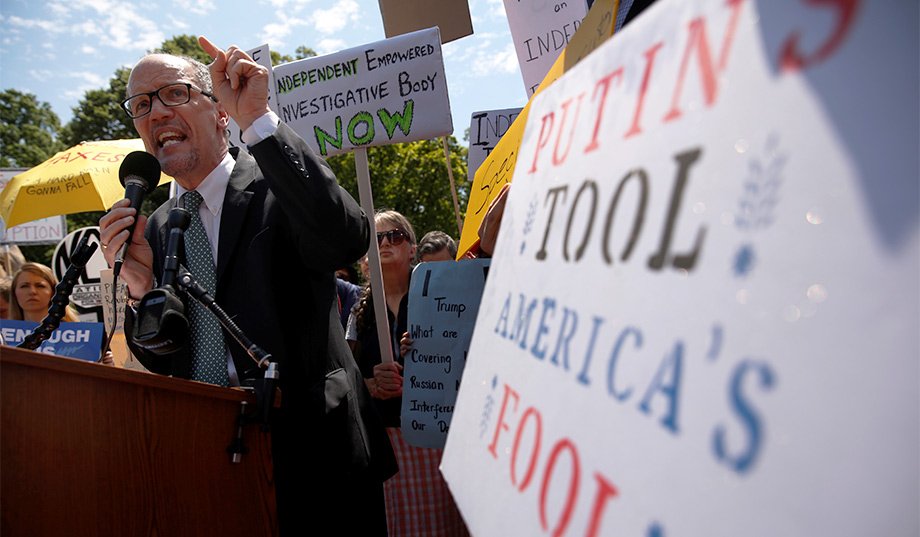
Is there a Democratic-party alternative to President Trump’s tax plan? Is there a Democratic congressional proposal to stop the hemorrhaging and impending implosion of Obamacare? Do Democrats have some sort of comprehensive package to help the economy grow or to deal with the recent doubling of the national debt? What is the Democratic alternative to Trump’s apparent foreign policy of pragmatic realism or his neglect of entitlement reform? The answers are all no, because for all practical purposes there is no Democratic party as we have traditionally known it. It is no longer a liberal (a word now replaced by progressive) political alternative to conservatism as much as a cultural movement fueled by coastal elites, academics, celebrities — and the media. Its interests are not so much political as cultural. True to its new media identity, the Democratic party is against anything Trump rather than being for something. It seeks to shock and entertain in the fashion of a red-carpet celebrity or MSNBC talking head rather than to legislate or formulate policy as a political party. The result is that in traditional governing terms, the Democratic party has recalibrated itself into near political impotency. Barack Obama ended the centrism of Bill Clinton and with it the prior Democratic comeback (thanks to the third-party candidacies of Ross Perot) from the disastrous McGovern, Carter, Mondale, and Dukakis years. Indeed, Obama’s celebrity-media/identity-politics/community-organizing model brought him more new voters than the old voters he lost — but so far, his new political paradigm has not proven transferable to any other national candidates. No wonder that over the eight years of the Obama administration, Democrats lost the majority of the state legislatures, the governorships, local offices, the Senate, the House, the presidency, and, probably, the Supreme Court. Most Democratic leaders are dynastic and geriatric: Bernie Sanders (75), Hillary Clinton (69), Elizabeth Warren (67), Diane Feinstein (83), Nancy Pelosi (77), Steny Hoyer (77), or Jerry Brown (79). They are hardly spry enough to dance to the party’s new “Pajama Boy” and “Hands Up, Don’t Shoot” music. Yet those not past their mid-sixties appear unstable, such as the potty-mouth DNC head Tom Perez and his assistant, the volatile congressman Keith Ellison. Or they still believe it is 2008 and they can rally yet again around “hope and change” and Vero possumus. That politicos are talking about an amateurish Chelsea Clinton as a serious future candidate reflects the impoverishment of Democratic political talent. In such a void, a traditionally progressive media, including the entertainment industry, stepped in and fused with what is left of the Democratic party to form the new opposition to the Republican party and in particular to Donald Trump. The aim now is to alter culture through the courts and pressure groups rather than to make laws. A disinterested observer would have seen that the Democratic antidote to Trumpism was a return to Bill Clinton’s focus on working-class, pocketbook issues — the issues that might win back swing voters in the proverbially blue-wall states. But that won’t happen. The Democratic party is now in the hands of Obama progressives, who in turn follow the lead of the hip, cool, and outraged media that have no responsibility other than to appear hip and cool and outraged. Trump apparently understands that and so focuses most of his invective not against a tired Nancy Pelosi or the shrill Chuck Schumer but at the major networks, mainstream newspapers, and Hollywood celebrities — the heart now of the progressive fusion party. Trump’s strategy is understandable. A recent study released by the Harvard Kennedy School and Shorenstein Center on Media, Politics, and Public Policy reported that in Trump’s first 100 days, 80 percent of major-media news coverage was negative (double the figure during President Obama’s first three months). More important, anti-Trump news constituted 41 percent of all media news coverage, a percentage three times greater than coverage accorded prior presidents. In clinical terms, we might call that an obsession. If it were not for Fox News’s much caricatured “fair and balanced” coverage (52 percent of its Trump coverage was negative, Harvard reported) to average in with other major print and television media, the anti-Trump bias would have been far greater — given that CNN and NBC ran almost no media coverage that portrayed Trump in a positive light (their coverage was 93 percent negative). The symptoms of the Media-Democratic party fusion range from the trivial to the profound. The merger is emblematized by the annual White House Correspondents Dinner, which has now fully morphed from a self-congratulatory night for Washington media insiders to a star-studded Petronian banquet of progressive celebrities. Operationally, the celebrity world and the media have institutionalized political obscenity and street the

Source: Progressive Media & Democrats Form New Anti-Trump Party | National Review

Leave a Reply

Your email address will not be published. Required fields are marked *