
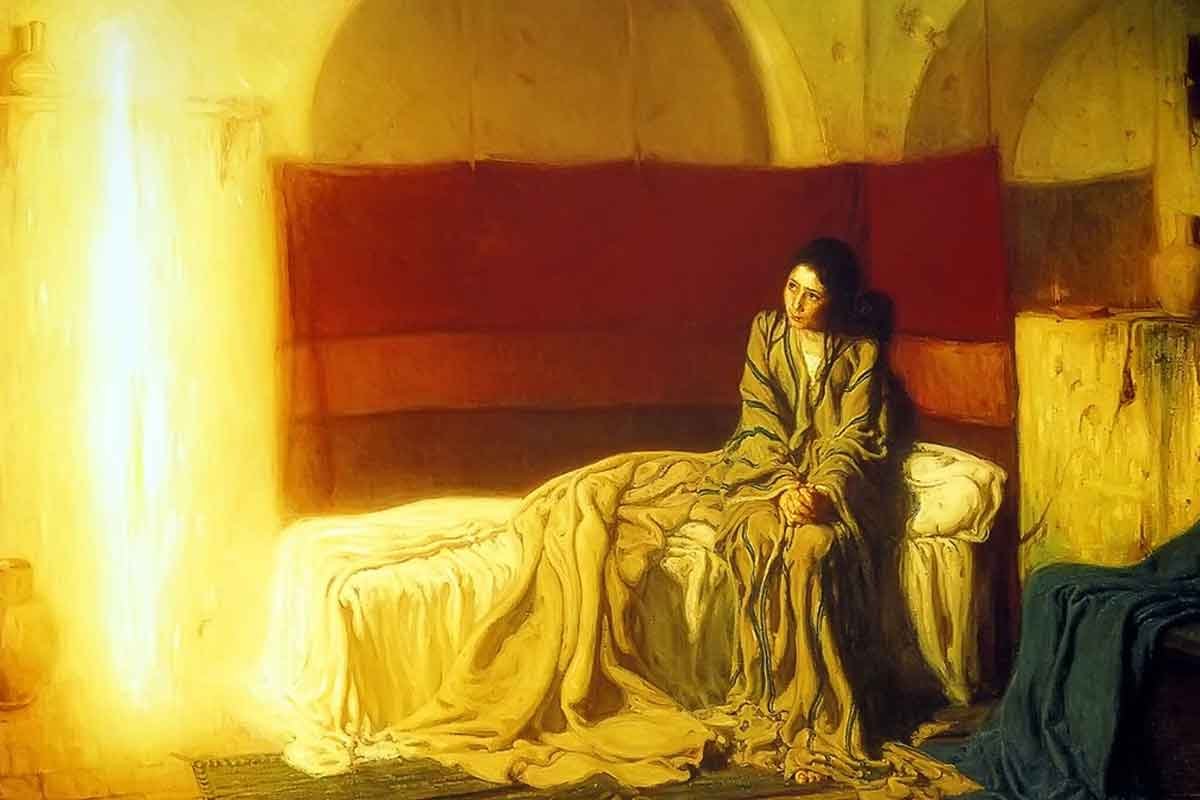
The specifically Christian idea of the Virgin Birth is one of the most controversial and confusing theological concepts around, and a Yuletide blog that didn’t take on the topic wouldn’t be doing its job.
It is not quite the most controversial verse in the Bible, but Luke 1:35 comes close. Mary has just replied to the angel Gabriel’s statement that she will be the mother of the Messiah with a question of her own: “How shall this be,” she says in the words of the King James Version, “seeing I know not a man?”
Don’t worry about that, says the angel. “The Holy Ghost shall come upon thee, and the power of the Highest shall overshadow thee: therefore also that holy thing which shall be born of thee shall be called the Son of God.”
In other words, Jesus would be born of a virgin, a woman who had not, in the biblical sense, known a man.
I only say this is not the most controversial verse in the Bible because the Virgin Birth of Jesus is one of the points on which most Muslims and Christians agree. In verse 21 of Sura 19 in the Quran, the angel tells Mary that although she has not known a man (verse 18) yet God will give her a child. A 2012 Pew Forum poll found that 32 percent of the world’s population is Christian and 23 percent is Muslim, so there are an awful lot of people who believe this—although of course not all Christians nor all Muslims accept the idea that their respective scriptures are literally true. Still, since both Christianity and Islam are strongest in developing countries where more literal views of scripture are widely accepted, close to one half of the world’s population probably believes that the mother of Jesus was a virgin at the time of she gave birth. There aren’t many more propositions that are more widely believed than this; more people believe that Jesus was born of a virgin than believe that free markets work, that life arose through a process of biological evolution, or that the square of the hypotenuse is equal to the sum of the squares of the other two sides.