
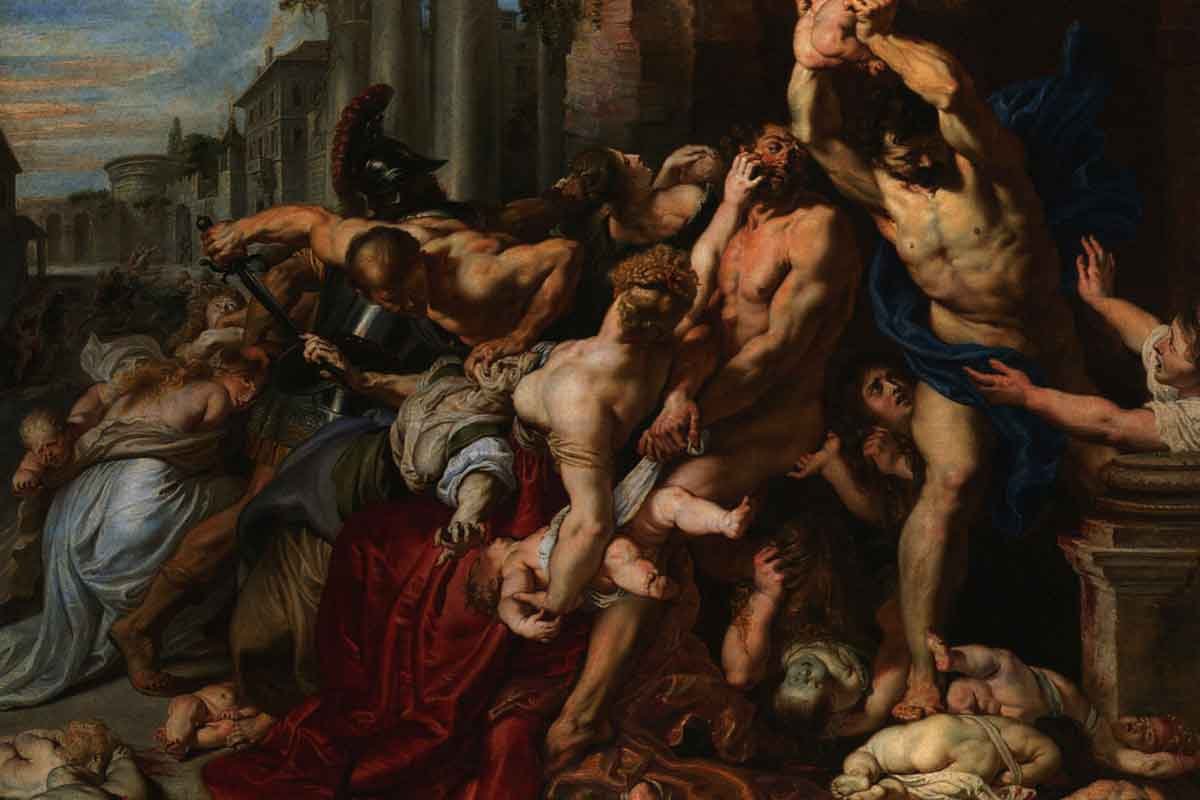
Everybody wants to reduce Christmas to a Christmas card: we’d like this to be a pretty and sentimental tale. But today, the third day after the present orgy beneath the tree, is also the day that the traditional liturgical calendar tries to slap us into serious reflection on the meaning of the event, jolting us out of our turkey comas and eggnog overdoses with an unforgettably grim story.
Church calendars mark December 28 as Holy Innocents’ Day, the day we remember the deaths of the babies in Bethlehem who were murdered at Herod’s command. Matthew is our source for the story (Matthew 2:1-18), and the Three Wise Men are the unwitting bearers of doom. The Three Kings or Wise Men who famously gifted the baby Jesus with gold, frankincense, and myrrh also set off a train of events that resulted in the most chilling story of mass murder in the New Testament.
The Three Wise Men mentioned in the Bible seem to have been astrologers; it might be better to call them “astrologists” because astrology in their time combined elements that today we would call science with what today would be called balderdash. Keeping track of the tides, the seasons, and the calendar by watching the heavens were all things wise men used to do. Keeping track of and learning to predict the movements of the sun and the moon helped early civilizations forecast tides and winds. The ability to predict solar and lunar eclipses was one of the earliest and greatest scientific accomplishments of the human mind; at the time, what we call astrology and what we call astronomy were still joined at the hip. The wise men (and women) of old made a great intellectual leap when they realized that the movement of heavenly bodies influenced events on the earth. They may not have understood gravity, but they figured out that there was some kind of connection between the movement of the moon and the state of the tides. If they also believed that the same invisible rays from the stars and the planets that brought the changing seasons and raised the tides controlled the tides of human history too, they are not the only intellectuals in world history to have pressed a theory past its breaking point or to have assumed that correlation and causation are the same.