
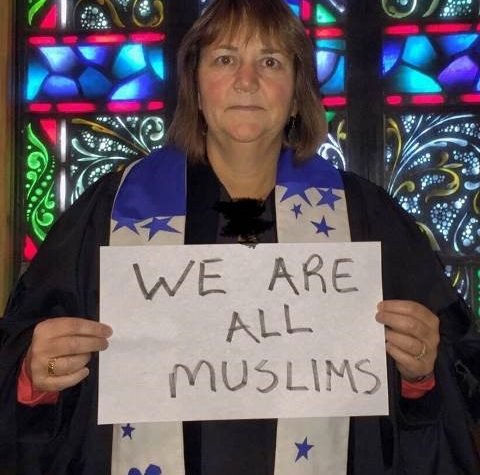
In light of the dramatically pro-schism action of the United Methodist Church’s Western Jurisdiction to propose non-celibate lesbian activist Karen Oliveto to be a new bishop (currently being challenged), it seems worth reviewing her rather radical theological worldview. The following is a reprint, with some slight edits, of an article I originally wrote in 2005 on some presentations given at a gay United Methodist gathering by Ms. Oliveto, before she “outed” herself as a partnered lesbian.
The plenary bible studies at the Reconciling Ministries Network’s (RMN) “Hearts on Fire” Convocation, held at Lake Junaluska from September 2-5, 2005 were led by Rev. Dr. Karen Oliveto. As pastor of Bethany United Methodist Church in San Francisco, she made headlines last year by officiating at a number of same-sex “marriage” ceremonies, in violation of the United Methodist Book of Discipline she vowed to uphold.
Oliveto was supposed to have been joined by the Rev. Dr. Jeffrey Kuan, who like Oliveto is currently a professor at the Pacific School of Religion in Berkeley, California. However, Kuan was unable to make it to the conference, and so Oliveto explained that she was charged with relating what he would have said as well as conveying her own biblical exegesis.
On the opening night, Oliveto preached on Acts 1:6-11, which describes Christ’s ascension to heaven. She speculated that Jesus laughed at his disciples for continuing to look up as he was lifted out of their sight, trying to “keep their eyes locked on a past that is no longer,” rather than looking down and moving on.
Curiously, the RMN leader proceeded to use this as a biblical argument for acceptance of homosexual practice. While our church “remain[s] rooted to … old traditions” which “may have served us once,” being “rooted in the past” will deprive us of enjoying what God is doing here and now, she warned. By not affirming homosexual practice, Oliveto lamented that the United Methodist Church “has kept its face turned to a past that no longer serves the whole family of God.”
Furthermore, the seminary professor argued that just as the church had overcome “Scriptural norms or church traditions” to reject racism and accept women’s ordination, the church now needs to discard Scriptural and traditional standards in order to affirm homosexuality. Oliveto did not explore the possibility of there being Scriptural reasons to oppose racism and support women in ministry.
Oliveto found encouragement for the Reconciling Ministry Network’s “progressive theology” and in the Pentecost story of the disciples speaking in diverse tongues through the power of the Holy Spirit. While some may say that a weakness of progressive theology is a “lack of cohesiveness,” she encouraged conference participants to embrace this as a great strength. Theological liberals are not like “the religious right,” which is “univocal,” Oliveto boasted. Therefore, she urged her audience to not “expect one uniform progressive theology” or “suppress other views,” presumably meaning as long as those un-suppressed views are not conservative.
After lauding its lack of “univocality,” Oliveto delimited the boundaries of progressive theology. It should be framed by “pluralism,” “feminism,” “liberationism,” “post-colonialism,” and “ecological and environmental responsibility,” she said. She exhorted “Hearts on Fire” participants to “openly embrace the agenda that drives progressive theology.”
The seminary professor also cautioned her audience against taking too high a view of Scripture. “The text, the Bible, is not God,” she explained, and “biblical theology” requires addressing both “the benefits and flaws” of Scripture.
On Sunday, Oliveto directly tackled alleged flaws in Scripture. She repudiated at length what she the “theology of election and chosenness” that she traced in the Bible from God’s choosing Isaac over Ishmael to the Jews being God’s chosen people and on through the New Testament’s teaching that followers of Jesus Christ have a special relationship with God that non-Christians do not have. She also specifically criticized the language used by Jesus Christ Himself of separating sheep and goats in Matthew 25:31-46. Oliveto blamed this acknowledged biblical theme for the evils of colonization, slavery, “destruction of native cultures and religions,” women’s subordination, racism, and current oppression of “the gays and lesbians.”
In contrast, Oliveto had asserted that the message of Jesus (at least in what she judged to be the good parts of the Bible) is that “no one is to be excluded from the community” of faith. She also argued that God’s calling Peter to evangelize Cornelius the Gentile in Acts 10 signified a comprehensive razing of barriers that divide “God’s people.”
In her sermon during the closing worship, she criticized St. Paul for casting a demon out of the slave girl in Acts 16:16-18. Oliveto encouraged her audience to question the traditional interpretation that this exorcism was “an act of liberation” for the girl. Negatively comparing Paul’s response to the slave girl to his subsequent saving of the jailer, Oliveto asserted that Paul was not motivated by compassion for the slave girl and noted that the text does not say that she found salvation.
The RMN leader went on to defend the demon’s possession of the slave, as this demon helped enrich her owners by giving her fortune-telling abilities. Oliveto declared that by casting the demon out of the girl, Paul did nothing to make the girl’s life better and “probably made it worse” as she was now “damaged goods.” Oliveto was very concerned by “questions about the imposition of religious values, in this case religious values,” such as if the exorcism was really good for the slave girl and whether she wanted to be exorcised. However, she did not explore the possibility of demon possession having had any detrimental effect upon the girl.
At another point, Oliveto shared an anecdote apparently meant to encourage her audience about the future. Two men that she knew had been “married” in a church service and there had been some concern about how one of the men’s son, Cliff, would accept it. But sometime after the union, Cliff was playing with a good (male) friend and exclaimed that they should get married when they grew up. Overhearing, mother of the friend told Cliff not to be silly, as he knew that boys could not get married to each other. But Cliff just looked up at her “like she was crazy” and declared, “in my church, they can!”